How to Start a Devotional Journal: Format, Example, Prompts
Scripture writingPublished ・Updated ・Penned Grace editors
Short answer
A devotional journal entry can be four lines: the verse, one thing you notice, one thing it means for today, and a one-sentence prayer. You need a notebook, a pen and a Bible. Start with five to ten minutes at the same time each day, and use a prompt when the page stays blank.

A devotional journal is a notebook where you write down a passage of scripture and your response to it. It is a record of what you read and what you prayed. Most people who give up do so because each entry feels like it has to be long or profound. It does not.
What you need
- A notebook. Lined, dotted or blank. A small one you will actually carry beats a beautiful one you are afraid to write in.
- A pen. If you write in a thin-paper Bible, a fine tip (around 0.3 to 0.5 mm) bleeds through less.
- A Bible. Any translation you can read comfortably. The verses on this page are from the Berean Standard Bible (BSB).
- A plan for what to read. One book of the Bible or a short reading plan saves you from deciding every morning.
A simple four-line format
Each entry has four parts. Label them in the margin so you can find your way back later.
- Verse: copy one to three verses by hand.
- Notice: one thing you see in the text. A repeated word, who is speaking, a promise.
- Today: one place it touches your life right now, as specific as you can make it.
- Pray: one or two sentences back to God.
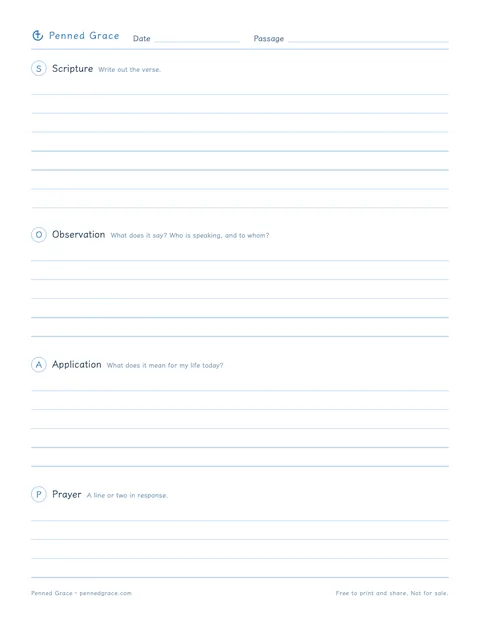
This is close to the SOAP method (Scripture, Observation, Application, Prayer), which many churches teach. Our SOAP Bible study guide covers it in more detail, with a longer example and common mistakes.
A devotional journal example
Because of the loving devotion of the LORD we are not consumed, for His mercies never fail. They are new every morning; great is Your faithfulness! (Lamentations 3:22–23, BSB)
Notice: Lamentations is a book of grief over the fall of Jerusalem. These lines sit in the middle of that grief, and the writer has not left it behind.
Today: Yesterday went badly and I woke up still carrying it. This morning is a new one.
Pray: Lord, thank you that your mercy did not run out overnight. Help me speak kindly at the meeting today.
The whole entry took about eight minutes, most of it copying the verse.
30 Christian journaling prompts
Use one when the notice or today line stays blank. You do not need to answer more than one per day.
About the passage
- Which word or phrase would I underline?
- Who is speaking, and who is listening?
- What happens in the verses just before and after?
- Is there a command, a promise or a warning here?
- What question would I ask the writer if I could?
- What does this passage repeat?
About God
- What does this passage show me about who God is?
- Where do I see God’s patience in it?
- What does Jesus do or say here that surprises me?
- Which name or title for God appears, and what does it mean to me?
- What has God already done for me that this reminds me of?
- Is there something about God I find hard to accept in this text?
About my day
- What am I worried about this morning?
- Where do I need wisdom today?
- Who will I see today, and how could this verse shape how I treat them?
- What is one small step I could take before tonight?
- What am I trying to control that I could hand over?
- Where did I fall short yesterday?
Gratitude
- Name three ordinary things I am thankful for.
- Who has shown me kindness this week?
- What prayer has God answered, even partly?
- What is good about the season I am in, even if it is hard?
- What did I enjoy yesterday that I almost missed?
- Which verse has stayed with me this month, and why?
Prayer
- Who do I want to pray for by name?
- What do I need to confess?
- What would I ask for if I believed God was listening closely?
- Can I turn the verse I copied into a prayer, word for word?
- What do I want to say to God that I have not said out loud?
- Which request from last week can I check on and update?
Bible journaling for beginners
Bible journaling usually means writing or drawing directly in the margins of a Bible, often a journaling Bible with wide, lined margins. You do not need to be an artist. Underlining a verse, writing a date beside it and adding one line of response is Bible journaling too. If you are not sure the habit will last, start in a notebook you already own and decide about a journaling Bible after a few months.
How to keep going
- Tie it to something you already do. Coffee, the bus ride, the first ten minutes after the kids leave.
- Stay in one book. Philippians has 4 chapters and James has 5. A few verses a day takes you through either in about a month.
- Date every entry. Reading back over three months of dates is encouraging, gaps included.
- Allow short days. A verse and one sentence counts. So does a single prayer line.
If you want a calmer, less structured page for the evening, see mindful journaling. For copying scripture as its own habit, see how to start handwriting scripture.
Paper or app
You can print a free SOAP devotional page in US Letter or A4, with a box for each step. Penned Grace lets you write scripture by hand, letter by letter, on iPhone, iPad or Android, with your finger or Apple Pencil, and your handwriting stays with the verse. It is free to download.
Common questions
What do you write in a devotional journal?
The verse or passage you read, what you notice in it, what it means for your day, and a short prayer. Some people add a line of thanks or a prayer list.
What is the difference between a devotional journal and Bible journaling?
A devotional journal is usually a separate notebook. Bible journaling usually means writing or drawing in the margins of the Bible itself, often a wide-margin journaling Bible. Both can follow the same four steps.
Do I need a special journaling Bible to start?
No. Any notebook and any Bible will do. If you keep the habit for a few months and want your notes beside the text, a wide-margin Bible is an option then.
How long should a devotional journal entry be?
There is no set length. Four short lines is a complete entry, and on a slow morning you can write a page.
Or write it by hand in the app

Penned Grace, the scripture writing app
Let God’s word hold us close
Works on iOS and Android, on phones and tablets.
Ad-free writing, always.
- Free to download
- No sign-up
- Works offline



Scan with your phone to download
On Android? Get it on Google Play