The SOAP Bible Study Method: A Simple Guide with an Example
Scripture writingPublished ・Updated ・Penned Grace editors
Short answer
SOAP stands for Scripture, Observation, Application and Prayer. You write out a verse, note what it says, think about what it means for your life today, and respond in a short prayer. Some days a verse and one sentence is enough.

Many people want to keep a devotional journal but stall on the first line. What should I write, and how much is enough? The SOAP method gives you four small steps, and none of them needs to be long.
What SOAP stands for
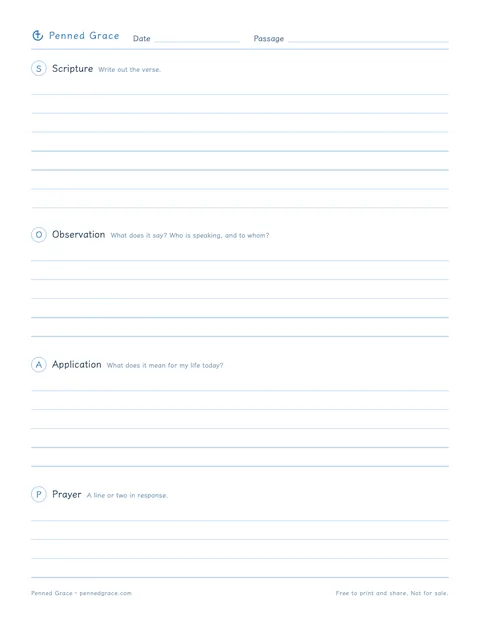
- Scripture: write out the verse or short passage you read today.
- Observation: what does it say? Who is speaking, and to whom?
- Application: what does it mean for my life today?
- Prayer: respond to God in a line or two.
The method is often credited to pastor Wayne Cordeiro, and it is used by many churches and small groups. You do not have to fill all four parts every day. Some days a verse and one sentence is a whole entry.
A SOAP example
Scripture: “The LORD is my shepherd; I shall not want.” (Psalm 23:1)
Observation: David pictures God as a shepherd and himself as a sheep. Sheep do not find pasture on their own.
Application: I have been worrying about work all week, as if everything depends on me.
Prayer: Lord, today I hand tomorrow over to you.
A full SOAP entry
The example above is the short version. Here is what a longer entry can look like on a day when you have fifteen minutes.
Scripture: “Come to Me, all you who are weary and burdened, and I will give you rest.” (Matthew 11:28, BSB)
Observation: Jesus is speaking to a crowd. Just before this, he has rebuked towns that saw his miracles and did not repent (Matthew 11:20–24), and then he thanks the Father for revealing these things to little children (11:25–27). The invitation is open to anyone who is weary. In the next verse he says, “Take My yoke upon you.” He offers rest along with a yoke, so the rest comes from walking with him, not from having nothing to carry.
Application: I have been treating rest as something I earn after the list is done, and the list is never done. This week I will stop for five minutes after lunch, before I open my email again, and read this verse.
Prayer: Jesus, I am tired, and I have been carrying things you did not ask me to carry. Teach me what your yoke feels like. Help me to stop at lunch tomorrow and come to you first.
The observation stays with the text and its context, and the application names one specific thing to do. Those two habits make the most difference in a SOAP journal.
Why write the S by hand
The first step is the one most people rush. Writing the verse out word by word, instead of copying and pasting it, makes you notice words you would normally skim, and it is often where the observation begins.
Common SOAP mistakes
- Choosing a passage that is too long. A whole chapter leaves you with too much to observe. One to three verses is usually enough for a single entry.
- Skipping the observation. It is tempting to jump from the verse straight to “what this means for me.” Spend a minute on who is speaking, to whom and why, and read the verses before and after.
- Writing a general application. “I should trust God more” is true but hard to act on. Try to name one situation or one step for today or tomorrow.
- Turning the prayer into a summary. The P is where you speak to God. It can be a single honest sentence.
- Treating every entry as a test. Some days the observation is one line and the prayer is three words. A short entry still counts.
SOAP and free-form journaling
In a free-form journal you start wherever you are: your day, a worry, something you are thankful for. SOAP starts with a passage and works outward, so the text stays at the center of the entry. Free-form journaling helps you process what is happening in your life. SOAP helps you read the Bible carefully and respond to it. Many people use both, a SOAP entry in the morning and a few free lines at night.
How to choose a passage
If you follow a reading plan, pick one or two verses from that day’s reading. If not, short books such as Philippians, James or 1 John work well because you can move through them a few verses a day. Psalms and Proverbs are also good starting points. Staying in one book for a few weeks lets each entry build on the one before.
Ten questions for when you get stuck
- Which word in this passage made me stop?
- If I could remember only one line, which would it be?
- What does this passage show me about who God is?
- Is there a command, a promise or a warning here?
- How am I feeling today, and does this passage speak to it?
- Is there something I want to give thanks for?
- Is there something I need to let go of?
- Who do I want to pray for?
- What is one small thing I could do tomorrow?
- Where did my hand slow down as I wrote?
Paper or app
You can print a free SOAP devotional page with a space for each step. If you would rather write on your phone or iPad, Penned Grace lets you handwrite the verse, and your handwriting stays on the page. You can keep the reflection on the printed SOAP page.
Common questions
What does SOAP stand for in Bible study?
Scripture, Observation, Application and Prayer.
Who created the SOAP Bible study method?
It is often credited to pastor Wayne Cordeiro, and it is used by many churches and small groups.
Is there a free SOAP Bible study template?
Yes. Penned Grace offers a free printable SOAP devotional page in US Letter and A4, with a space for each step.
Do I have to fill in all four parts every day?
No. Some days a verse and one sentence is a whole entry.
Or write it by hand in the app

Penned Grace, the scripture writing app
Let God’s word hold us close
Works on iOS and Android, on phones and tablets.
Ad-free writing, always.
- Free to download
- No sign-up
- Works offline



Scan with your phone to download
On Android? Get it on Google Play