Philippians 4:13 Meaning: Context and 4:6–7 in Full (BSB)
Bible verses by topicPublished ・Penned Grace editors
Short answer
“I can do all things through Christ who gives me strength” (Philippians 4:13, BSB) comes in a passage where Paul writes about contentment from prison. “All things” points back to the situations in verse 12: humble and abounding, filled and hungry, plenty and need. Philippians 4:6–7 says to be anxious for nothing, and the peace of God will guard hearts and minds.
Philippians 4:13 in the BSB reads, “I can do all things through Christ who gives me strength.” It sits in a passage about contentment: verse 11 says “I have learned to be content regardless of my circumstances,” and the verses after it thank the Philippian church for their support. “All things” points back to the situations Paul lists in verse 12: living humbly and abounding, being filled and being hungry, having plenty and having need. Below are verses 10–13 in full, then Philippians 4:6–7 (“Be anxious for nothing”), and the whole of 4:4–9.
Philippians 4:13 meaning
In plain terms, Paul is saying that through the one who gives him strength, he can get through every situation, whether he has much or little. Read after verses 11 and 12, “all things” is about learning to stay steady, not growing proud when things are plentiful and not collapsing when they are not. He wrote it from prison, in answer to a gift his friends had sent.
The Greek behind the end of the verse is “the one who strengthens me.” The verse itself does not name Christ. The BSB and KJV supply “Christ,” while the ESV and NIV say “him,” and the context (4:1, 4:7, 4:19) makes clear who is meant.
Context: Philippians 4:10–13 (BSB)
10Now I rejoice greatly in the Lord that at last you have revived your concern for me. You were indeed concerned, but you had no opportunity to show it.
11I am not saying this out of need, for I have learned to be content regardless of my circumstances.
12I know how to live humbly, and I know how to abound. In any and every situation I have learned the secret of being filled and being hungry, of having plenty and having need.
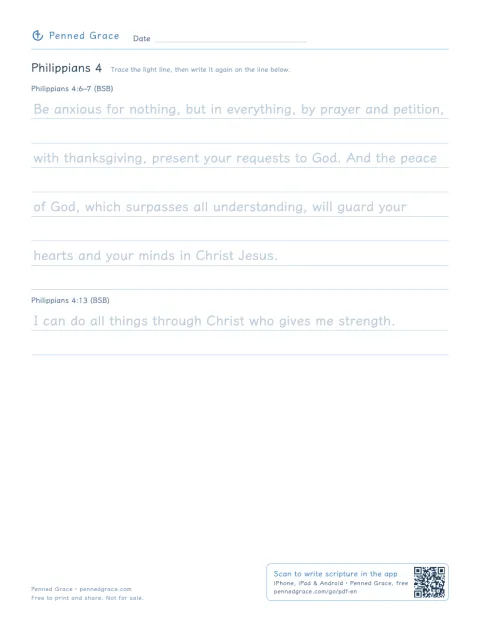
13I can do all things through Christ who gives me strength.
Philippians is a letter from the apostle Paul to the church at Philippi. He mentions being in chains (1:7, 1:13). Tradition places the letter in Rome, around AD 60 to 62, though some scholars suggest Ephesus or Caesarea. The Philippians had sent Epaphroditus with a gift for his needs (2:25), and 4:10–20 is Paul’s thanks.
Verse 10: joy at their concern
“You were indeed concerned, but you had no opportunity to show it.” Paul first affirms their care before he says anything about the gift.
Verses 11–12: the secret of contentment
Paul opens verse 11 by saying he is not speaking out of need, and that he has “learned to be content regardless of my circumstances.” “Learned” shows that contentment took practice. Verse 12 sets out three pairs of situations: humble and abounding, filled and hungry, plenty and need. In all of them, he says, he has learned the secret.
Verse 13: where the strength comes from
Verse 13 answers the question the previous two verses raise: how can anyone stay steady through such ups and downs? The answer is the one who gives him strength.
Verses 14–18: still grateful
Paul goes on, “Nevertheless, you have done well to share in my affliction,” and recalls that the Philippians were the only church to partner with him from the early days (4:15–16). By verse 18 he says, “I have all I need and more.” The focus of the whole passage is contentment, gratitude and mutual support.
Can I use Philippians 4:13 for exams or sports?
It is often written on cards for students and athletes. That is fine, and it fits best when it reminds someone to keep going through a hard stretch, or that their worth does not hang on a score or a result, which matches what Paul was writing about. For exam season, see more verses in Bible verses for encouragement cards.
Philippians 4:6–7: be anxious for nothing
6Be anxious for nothing, but in everything, by prayer and petition, with thanksgiving, present your requests to God.
7And the peace of God, which surpasses all understanding, will guard your hearts and your minds in Christ Jesus.
These two verses come earlier in the chapter and are often quoted alongside 4:13. “Be anxious for nothing” means holding on to no worry. Paul gives a practice: bring what you want to God through prayer, petition and thanksgiving. Verse 7 then says the peace of God “will guard your hearts and your minds in Christ Jesus.” That peace arrives before the situation is solved, which is why it “surpasses all understanding.”
Just before this, 4:2 asks two women in the church to “agree with each other in the Lord,” so the church was not without strain, and 4:5 says “The Lord is near,” which is part of why anxiety can loosen.
Philippians 4:4–9 full text (BSB)
4Rejoice in the Lord always. I will say it again: Rejoice!
5Let your gentleness be apparent to all. The Lord is near.
6Be anxious for nothing, but in everything, by prayer and petition, with thanksgiving, present your requests to God.
7And the peace of God, which surpasses all understanding, will guard your hearts and your minds in Christ Jesus.
8Finally, brothers, whatever is true, whatever is honorable, whatever is right, whatever is pure, whatever is lovely, whatever is admirable—if anything is excellent or praiseworthy—think on these things.
9Whatever you have learned or received or heard from me, or seen in me, put it into practice. And the God of peace will be with you.
Verses 4 to 6 cover rejoicing, gentleness and prayer, verse 8 lists six things worth thinking about (true, honorable, right, pure, lovely, admirable), and verse 9 says to put into practice what the Philippians learned, and the God of peace will be with them. Verse 7 speaks of the peace of God, and verse 9 of the God of peace.
Write it out: five days
Write one verse a day, then spend a minute on where it applies:
| Day | What to write | Verse |
|---|---|---|
| Day 1 | Rejoice in the Lord always. I will say it again: Rejoice! | 4:4 |
| Day 2 | Let your gentleness be apparent to all. The Lord is near. | 4:5 |
| Day 3 | Be anxious for nothing, but in everything, by prayer and petition, with thanksgiving, present your requests to God. | 4:6 |
| Day 4 | And the peace of God, which surpasses all understanding, will guard your hearts and your minds in Christ Jesus. | 4:7 |
| Day 5 | I can do all things through Christ who gives me strength. | 4:13 |
After day 5 you can write 4:11–12 to read 4:13 in its setting. For more short verses to copy, see short Bible verses to memorize, and the SOAP method for adding notes.
Printable
The free printables page has lined copywork sheets in US Letter and A4 you can use for any of these verses. Penned Grace lets you write scripture by hand, letter by letter, on iPhone, iPad or Android, with your finger or Apple Pencil. It is free to download.
Common questions
What does Philippians 4:13 mean?
Paul, writing from prison, says he can get through every situation through the one who gives him strength. “All things” refers to the situations listed in verse 12: being humble or abounding, filled or hungry, having plenty or having need.
Does “I can do all things” mean I can achieve anything?
In context, Paul is writing about learning to be content, whether he has much or little. Verse 11 says, “I have learned to be content regardless of my circumstances.”
What does Philippians 4:6–7 mean?
Verse 6 says to be anxious for nothing and to bring requests to God with prayer, petition and thanksgiving. Verse 7 says the peace of God, which surpasses all understanding, will guard your hearts and minds in Christ Jesus.
Is Philippians 4:13 a good verse for exams?
It is often used that way. It fits best as a reminder to keep going through a hard stretch, which is closer to what Paul was writing about. Add a line of your own to the person taking the exam.
Or write it by hand in the app

Penned Grace, the scripture writing app
Let God’s word hold us close
Works on iOS and Android, on phones and tablets.
Ad-free writing, always.
- Free to download
- No sign-up
- Works offline



Scan with your phone to download
On Android? Get it on Google Play