Fruit of the Spirit Meaning: Galatians 5:22–23 Explained
Bible verses by topicPublished ・Penned Grace editors
Short answer
The fruit of the Spirit is nine qualities listed in Galatians 5:22–23: love, joy, peace, patience, kindness, goodness, faithfulness, gentleness and self-control. Paul sets them against the 15 “acts of the flesh” in 5:19–21. The Greek word for fruit is singular, so many commentators read the nine as aspects of one life.
The fruit of the Spirit is the list of nine qualities in Galatians 5:22–23: love, joy, peace, patience, kindness, goodness, faithfulness, gentleness and self-control. Below are the two verses, what each of the nine means with one related verse, why Paul says “fruit” in the singular, and how the list sits against the “acts of the flesh” in the same passage.
Fruit of the Spirit verse (Galatians 5:22–23)
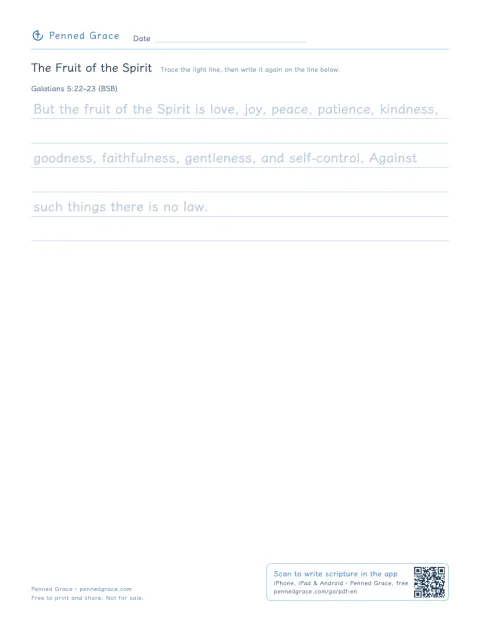
But the fruit of the Spirit is love, joy, peace, patience, kindness, goodness, faithfulness, gentleness, and self-control. Against such things there is no law. (Galatians 5:22–23, BSB)
These verses come from Paul’s letter to the churches of Galatia. The letter argues that Gentile believers do not need to take on the Jewish law first, because Christ has set people free (5:1). Chapter 5 then warns that freedom must not become an opportunity for the flesh, and calls believers to serve one another in love (5:13). The fruit of the Spirit appears in that setting.
How many fruits of the Spirit are there?
Nine in Galatians 5:22–23, and most Protestant churches teach nine. Catholic tradition also speaks of twelve fruits: the Catechism (1832) lists twelve, and the Latin Vulgate text of Galatians adds modesty, continence and chastity to the nine. If you are memorizing or copying the passage, follow the translation you are using.
Some people sort the nine into three groups: toward God (love, joy, peace), toward others (patience, kindness, goodness) and toward oneself (faithfulness, gentleness, self-control). That grouping is a later memory aid, and the text does not divide them.
The nine fruits and what they mean
1. Love (agape)
The Greek is agape, a love that seeks the other person’s good without first asking what it will get back. Paul tells the Galatians to “serve one another in love” (5:13) and says the whole law is fulfilled in one command, love your neighbor as yourself (5:14). Love heads the list, and many readers treat the other eight as different faces of it.
A new commandment I give you: Love one another. As I have loved you, so you also must love one another. (John 13:34, BSB)
2. Joy (chara)
The Greek is chara. This joy does not depend on circumstances, and in Scripture it often sits alongside hardship. In Nehemiah 8 the people have just heard the law read and are weeping, and they are told not to grieve.
Then Nehemiah told them, “Go and eat what is rich, drink what is sweet, and send out portions to those who have nothing prepared, since today is holy to our Lord. Do not grieve, for the joy of the LORD is your strength.” (Nehemiah 8:10, BSB)
3. Peace (eirene)
Eirene covers inner calm and also peace between people, so it is the opposite of the “discord” and “rivalries” in 5:20. Paul uses the same word in Philippians 4:7.
And the peace of God, which surpasses all understanding, will guard your hearts and your minds in Christ Jesus. (Philippians 4:7, BSB)
4. Patience (makrothymia)
Makrothymia literally means “long of temper”: putting up with people for a long time without losing your temper. It is the word behind “love is patient” in 1 Corinthians 13:4. Some translations render it longsuffering or forbearance.
with all humility and gentleness, with patience, bearing with one another in love, (Ephesians 4:2, BSB)
5. Kindness (chrestotes)
Chrestotes is a warm, helpful attitude toward others. Titus 3:4 uses the same word of God’s kindness toward people. Some commentators treat kindness as the attitude and goodness, the next item, as the action. That is a memory aid, and the text does not say so.
But when the kindness of God our Savior and His love for mankind appeared, (Titus 3:4, BSB)
6. Goodness (agathosyne)
Agathosyne is goodness of character that shows in what a person does. Ephesians 5:9 describes “the fruit of the light” in very similar terms.
for the fruit of the light consists in all goodness, righteousness, and truth. (Ephesians 5:9, BSB)
7. Faithfulness (pistis)
Pistis is usually translated “faith” in the New Testament. In this list it leans toward reliability: being trustworthy and keeping your word. 1 Corinthians 4:2 names the same quality in a steward.
Now it is required of stewards that they be found faithful. (1 Corinthians 4:2, BSB)
8. Gentleness (prautes)
Prautes is strength under control, not forcefulness, and a willingness to be taught. Jesus describes himself as “gentle and humble in heart.” Paul also says in Galatians 6:1 that someone caught in a sin should be restored in a spirit of gentleness.
Take My yoke upon you and learn from Me, for I am gentle and humble in heart, and you will find rest for your souls. (Matthew 11:29, BSB)
9. Self-control (enkrateia)
Enkrateia is mastery over your own appetites, temper and speech. In 1 Corinthians 9:25 Paul compares it to an athlete’s training. It comes last in the list, opposite the “drunkenness, orgies” and “rage” of 5:20–21.
Everyone who competes in the games trains with strict discipline. They do it for a crown that is perishable, but we do it for a crown that is imperishable. (1 Corinthians 9:25, BSB)
Why “fruit” and why singular?
In 5:19 Paul speaks of the “acts” of the flesh, plural, and lists them one by one. In 5:22 he says “the fruit” of the Spirit in the singular and only then lists nine qualities. For that reason many commentators read the nine as aspects of one life. Others read them as nine separate qualities. The text does not settle it, and both readings are common.
Fruit has two features worth noticing. It grows rather than being manufactured: Jesus says, “The one who remains in Me, and I in him, will bear much fruit. For apart from Me you can do nothing” (John 15:5). And it is visible: “By their fruit you will recognize them” (Matthew 7:16).
The fruit of the Spirit also differs from the gifts of the Spirit. Gifts such as healing, prophecy and tongues are distributed by the Spirit “to each one as He determines” (1 Corinthians 12:11). The fruit is a character that every believer is expected to grow.
Context: Galatians 5:16–26 and the acts of the flesh
| Verses | What they say |
|---|---|
| 5:16–18 | Walk by the Spirit and you will not gratify the desires of the flesh. The two are opposed. |
| 5:19–21 | The acts of the flesh are listed, with a warning that those who practice them will not inherit the kingdom of God. |
| 5:22–23 | The fruit of the Spirit is listed. “Against such things there is no law.” |
| 5:24–26 | Those who belong to Christ have crucified the flesh. Since we live by the Spirit, let us walk in step with the Spirit, and not become conceited, provoking and envying one another. |
The BSB lists 15 acts of the flesh in 5:19–21. For readability they can be grouped (the grouping is mine; the text does not divide them): sexual (sexual immorality, impurity, debauchery), worship (idolatry, sorcery), relationships (hatred, discord, jealousy, rage, rivalries, divisions, factions, envy) and excess (drunkenness, orgies). Eight of the fifteen concern conflict between people, which echoes 5:15 and 5:26. Read side by side, patience, peace and kindness answer discord, rage and rivalries, and self-control answers drunkenness and orgies, though Paul does not pair them one for one.
Teaching the fruit of the Spirit to children
The nine fit a nine-day rhythm for children, one a day. Read the short paragraph above, ask the child for one small moment from that week, and have them write the word. Patience goes with waiting in line, self-control with the second cookie, gentleness with how they talk to a younger sibling. These qualities grow slowly, so there is no need to expect them all in a day.
Copying Galatians 5:22–23 by hand
Two verses are a good length for copywork. Write one fruit a day, note where it came up, and on day ten write the whole passage. For a longer piece, copy 5:16–26 and read the acts of the flesh and the fruit side by side.
The free printables page has a Chinese-language copywork sheet for Galatians 5:22–23 (Traditional and Simplified, A4). New to copying scripture? Start with how to start handwriting scripture, and for notes use how to keep a devotional journal.
Penned Grace lets you write scripture by hand, letter by letter, on iPhone, iPad or Android, with your finger or Apple Pencil. It is free to download and includes the Berean Standard Bible. For more verses to copy, see Bible verses for encouragement.
Common questions
How many fruits of the Spirit are there?
Nine in Galatians 5:22–23: love, joy, peace, patience, kindness, goodness, faithfulness, gentleness and self-control. Catholic tradition also speaks of twelve, adding items that come from the Latin Vulgate.
Where is the fruit of the Spirit in the Bible?
Galatians 5:22–23: “But the fruit of the Spirit is love, joy, peace, patience, kindness, goodness, faithfulness, gentleness, and self-control. Against such things there is no law.” The surrounding passage is 5:16–26.
Why is it “fruit” and not “fruits” of the Spirit?
In Galatians 5:22 the Greek word for fruit is singular, followed by nine items, while the “acts of the flesh” in 5:19 are plural. Many commentators read the nine as aspects of one life. Others read them as nine qualities. The text does not decide between them.
What is the difference between the fruit and the gifts of the Spirit?
Gifts such as healing, prophecy and tongues are given by the Spirit to each person as he determines (1 Corinthians 12:11). The fruit is a set of character qualities that every believer is expected to grow.
Or write it by hand in the app

Penned Grace, the scripture writing app
Let God’s word hold us close
Works on iOS and Android, on phones and tablets.
Ad-free writing, always.
- Free to download
- No sign-up
- Works offline



Scan with your phone to download
On Android? Get it on Google Play