Ecclesiastes 3 Meaning: A Time for Everything (3:1–8)
Bible verses by topicPublished ・Penned Grace editors
Short answer
Ecclesiastes 3:1–8 is a poem of 14 pairs, 28 “times” in all, beginning “To everything there is a season” and including “a time to be born and a time to die.” Verse 11 adds that God has made everything beautiful in its time. The passage is often read at funerals in English-speaking churches.
Ecclesiastes 3:1 says “To everything there is a season, and a time for every purpose under heaven,” and opens a short poem of 14 pairs, 28 “times” in all (3:1–8). “A time to be born and a time to die” is the line quoted most often. Below is the full passage in the Berean Standard Bible, what each part means, verse 11 (“He has made everything beautiful in its time”), the context of 3:1–15, and which verses people use for funerals, graduations and weddings.
Ecclesiastes 3:1–8 full text (BSB)
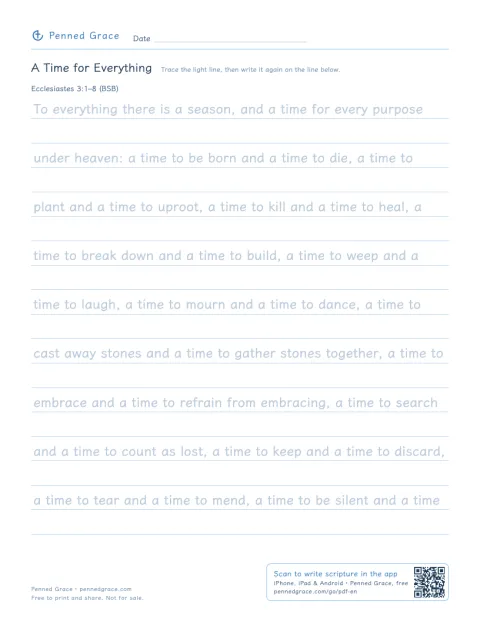
1 To everything there is a season, and a time for every purpose under heaven:
2 a time to be born and a time to die, a time to plant and a time to uproot,
3 a time to kill and a time to heal, a time to break down and a time to build,
4 a time to weep and a time to laugh, a time to mourn and a time to dance,
5 a time to cast away stones and a time to gather stones together, a time to embrace and a time to refrain from embracing,
6 a time to search and a time to count as lost, a time to keep and a time to discard,
7 a time to tear and a time to mend, a time to be silent and a time to speak,
8 a time to love and a time to hate, a time for war and a time for peace. (Ecclesiastes 3:1–8, BSB)
Verse 1 is the heading. Verses 2 to 8 each carry two pairs, making 14 pairs and 28 “times,” each pair built from opposites.
Who wrote Ecclesiastes
The book begins, “These are the words of the Teacher, the son of David, king in Jerusalem” (1:1). Tradition names Solomon, while many scholars date the book later and note that the author only ever calls himself the Teacher (Hebrew Qoheleth). Scholars differ on this. The tone of the whole book is set in 1:2, “Futility of futilities … Everything is futile”: the Teacher observes life “under the sun” and asks what a person gains from toil. So 3:1–8 sits inside an observation and should not be read as a simple motivational slogan. It describes how people’s days are filled with alternating, opposite moments.
What 3:1–8 means, section by section
3:1: the heading
“Season” and “time” are two Hebrew words for appointed moments. The emphasis falls on “every purpose under heaven”: every kind of experience has its time, including the ones nobody wants.
3:2: birth, death, planting
“A time to be born and a time to die” are the two ends of life. The second half, planting and uprooting, is the farming cycle, with a right season to put in and to pull out.
3:3: killing and healing, breaking down and building
Four actions, in pairs: harm and repair, demolition and rebuilding. Not every “time” in the poem is presented as good. Some are listed because they happen, and each has its moment.
3:4: weeping, laughing, mourning, dancing
This is the verse most often used for comfort. Mourning and dancing are set side by side, so grief has its time and joy has its time. Romans 12:15, “Rejoice with those who rejoice; weep with those who weep,” reads well alongside it.
3:5: stones and embracing
Commentators disagree about “casting away stones” and “gathering stones together.” Suggestions include clearing and working a field, warfare, and building, and the text does not say. “A time to embrace and a time to refrain from embracing” is closeness and distance, each with its proper moment.
3:6: searching and losing, keeping and discarding
Finding and losing, holding on and letting go are choices people make all through life. This verse is often quoted at times of transition such as graduation, moving or retirement.
3:7: tearing and mending, silence and speech
In the Old Testament, tearing clothes is a common sign of grief (for example Genesis 37:34), and mending is the recovery afterwards. The second half is about judgment in speech: when to stay with someone in silence and when to say something.
3:8: love and hate, war and peace
The final verse ends on the widest contrast, love and hate, war and peace. The poem begins with birth and death in 3:2 and ends with peace.
Ecclesiastes 3:11: “He has made everything beautiful in its time”
He has made everything beautiful in its time. He has also set eternity in the hearts of men, yet they cannot fathom the work that God has done from beginning to end. (Ecclesiastes 3:11, BSB)
Verse 9 asks the question, “What does the worker gain from his toil?” and verse 10 says God has given people this burden to occupy them. Verse 11 gives half an answer: each thing is beautiful in its time. It then says God has set eternity in human hearts. Readers take that as a longing for what lasts, or as an awareness of time as a whole. The verse ends by saying people cannot fathom what God has done from beginning to end. A person can see the moments but not the whole.
Verses 12 and 13 give a practical response: nothing is better than to rejoice and do good while living, and eating, drinking and finding satisfaction in work are a gift of God. Verses 14 and 15 say that what God does endures forever, and that he does it so people will fear him.
Context: Ecclesiastes 3:1–15
| Verses | Content |
|---|---|
| 3:1–8 | A time for everything: 14 pairs of opposite moments |
| 3:9–10 | What does toil gain? God has given people this burden |
| 3:11 | Beautiful in its time; eternity set in the heart; no one can fathom it all |
| 3:12–13 | Rejoice, do good, and enjoy food and work as God’s gift |
| 3:14–15 | What God does endures; he is to be feared |
From 3:16 the tone darkens. The Teacher sees wickedness even in the place of judgment and says humans and animals alike return to dust (3:19–20). That is why readings at weddings and graduations usually stop at 3:8 or 3:11.
Ecclesiastes 3 at funerals, graduations and weddings
In English-speaking churches Ecclesiastes 3:1–8 is often read at funerals. It is also quoted at many other turning points, because it places every stage of life inside one frame. Some suggestions by occasion:
| Occasion | Verses | Why |
|---|---|---|
| Funeral or memorial | 3:1–2, 3:1–8, 3:11 | “A time to die” places death inside time; 3:11 speaks of eternity and of what no one can fathom |
| Sympathy card | 3:4 | A time to weep and a time to laugh, a time to mourn and a time to dance |
| Graduation or transition | 3:1, 3:11 | One stage ends and another has its time |
| Wedding or engagement | 3:11 | Often used about waiting: “beautiful in its time” |
| New baby or birthday | First half of 3:2, “a time to be born” | Quote only the first half; the second half does not suit these cards |
The passage also lives on in popular music. Pete Seeger set words from Ecclesiastes 3 to music in 1959 as “Turn! Turn! Turn!” (he added the title phrase and the closing lines), and The Byrds’ recording reached number one on the Billboard Hot 100 in December 1965. For more occasions, see Bible verses for grief and wedding Bible verses.
Copying Ecclesiastes 3 by hand: nine days
Write one section a day and think about where it matches your own life right now:
- Day 1: 3:1, the heading
- Day 2: 3:2, birth, death, planting
- Day 3: 3:3, killing and healing, breaking down and building
- Day 4: 3:4, weeping, laughing, mourning, dancing
- Day 5: 3:5, stones and embracing
- Day 6: 3:6, searching, losing, keeping, discarding
- Day 7: 3:7, tearing, mending, silence, speech
- Day 8: 3:8, love, hate, war, peace
- Day 9: 3:11, beautiful in its time
Ecclesiastes 3 copywork
The free printables page has a Chinese-language copywork sheet for Ecclesiastes 3:1–8 (Traditional and Simplified, A4). New to copying scripture? Start with how to start handwriting scripture.
Penned Grace lets you write scripture by hand, letter by letter, on iPhone, iPad or Android, with your finger or Apple Pencil. It is free to download and includes the Berean Standard Bible. For another passage that pairs well with this one, see Psalm 23.
Common questions
What does Ecclesiastes 3 mean?
Ecclesiastes 3:1–8 says every kind of experience under heaven has its appointed time, in 14 pairs of opposites such as birth and death, weeping and laughing, war and peace. Verse 11 adds that God has made everything beautiful in its time, though no one can fathom all he has done.
How many “times” are in Ecclesiastes 3:1–8?
Twenty-eight, arranged as 14 pairs of opposites. Verse 1 is the heading, and verses 2 to 8 carry two pairs each.
Why is Ecclesiastes 3:1–8 read at funerals?
“A time to be born and a time to die” (3:2) places death inside the order of time, and the passage as a whole acknowledges weeping and mourning. Readings usually stop at 3:8 or 3:11, because the tone darkens from 3:16.
What does “beautiful in its time” mean in Ecclesiastes 3:11?
Each thing God has made has a right moment in which it is fitting. The verse then says God has set eternity in human hearts and that people cannot fathom the whole of his work. It is often quoted about waiting and accepting timing.
Or write it by hand in the app

Penned Grace, the scripture writing app
Let God’s word hold us close
Works on iOS and Android, on phones and tablets.
Ad-free writing, always.
- Free to download
- No sign-up
- Works offline



Scan with your phone to download
On Android? Get it on Google Play