Psalm 23 Meaning, Verse by Verse (Full Text and Printable)
Bible factsPublished ・Updated ・Penned Grace editors
Short answer
Psalm 23 is a six-verse psalm of David that begins “The LORD is my shepherd; I shall not want.” Verses 1–4 picture God as a shepherd leading and protecting his sheep, and verses 5–6 change the picture to a host who sets a table and anoints a guest. Midway through verse 4 the psalm stops speaking about God (“He”) and starts speaking to Him (“You”).

Psalm 23 has six verses and is one of the most quoted passages in the Bible. Below is the full text in the Berean Standard Bible (BSB), then what each verse means, how a few lines differ between English translations, and a printable page if you want to write it out.
Psalm 23 full text (BSB)
A Psalm of David. The LORD is my shepherd; I shall not want. (1)
He makes me lie down in green pastures; He leads me beside quiet waters. (2)
He restores my soul; He guides me in the paths of righteousness for the sake of His name. (3)
Even though I walk through the valley of the shadow of death, I will fear no evil, for You are with me; Your rod and Your staff, they comfort me. (4)
You prepare a table before me in the presence of my enemies. You anoint my head with oil; my cup overflows. (5)
Surely goodness and mercy will follow me all the days of my life, and I will dwell in the house of the LORD forever. (6)
The whole psalm is about 120 words in the BSB.
Psalm 23 meaning, verse by verse
Verse 1: The LORD is my shepherd
A Psalm of David. The LORD is my shepherd; I shall not want. (Psalm 23:1, BSB)
“LORD” in small capitals stands for God’s personal name in Hebrew. David knew the work firsthand: when Samuel came to anoint a new king, David was “tending the sheep” (1 Samuel 16:11), and he later told Saul he had fought off a lion and a bear to rescue lambs (1 Samuel 17:34–35). “I shall not want” means “I will lack nothing.” Verses 2 and 3 list what the shepherd provides.
Verse 2: Green pastures and quiet waters
He makes me lie down in green pastures; He leads me beside quiet waters. (Psalm 23:2, BSB)
Food and water are the two things a flock needs every day, and in dry country the shepherd has to find them. The KJV’s “beside the still waters” and the BSB’s “quiet waters” both describe calm water a sheep can drink from safely.
Verse 3: He restores my soul
He restores my soul; He guides me in the paths of righteousness for the sake of His name. (Psalm 23:3, BSB)
After food and rest, the shepherd also leads on the right paths “for the sake of His name,” so his own reputation is at stake in how the sheep are led.
Verse 4: The valley of the shadow of death
Even though I walk through the valley of the shadow of death, I will fear no evil, for You are with me; Your rod and Your staff, they comfort me. (Psalm 23:4, BSB)
This is the turning point. Verses 1–3 speak about God as “He.” From “for You are with me” onward, the psalmist speaks directly to God. The comfort in this verse comes from the shepherd being in the valley with the sheep. The rod was a club for driving off animals, and the staff was a long stick for guiding and pulling sheep back.
Translations differ on the Hebrew phrase behind “the valley of the shadow of death”:
| Wording | Translations |
|---|---|
| valley of the shadow of death | KJV, ESV, NASB, BSB |
| darkest valley | NIV, NRSV, NLT |
Both readings fit the verse. It covers any dark, dangerous place, and it is also why the psalm is so often read at funerals.
Verse 5: A table before my enemies
You prepare a table before me in the presence of my enemies. You anoint my head with oil; my cup overflows. (Psalm 23:5, BSB)
The picture changes from shepherd to host. Setting a table, anointing a guest’s head with oil and filling the cup were signs of hospitality. Jesus mentions the same custom when He tells a Pharisee, “You did not anoint My head with oil” (Luke 7:46). The host honors the guest while enemies can only watch.
Verse 6: Goodness and mercy will follow me
Surely goodness and mercy will follow me all the days of my life, and I will dwell in the house of the LORD forever. (Psalm 23:6, BSB)
The Hebrew verb behind “follow” is often used for chasing or pursuing, which is why the NLT and NET translate it “pursue.” The last phrase reads literally “for length of days.” Most English Bibles say “forever,” while the NRSV has “my whole life long” and the NET “for the rest of my life.”
Psalm 23 and the Good Shepherd
Jesus takes up the same picture in John 10:
I am the good shepherd. The good shepherd lays down His life for the sheep. (John 10:11, BSB)
Churches that follow the Revised Common Lectionary read Psalm 23 on the Fourth Sunday of Easter in all three years of the cycle, together with a reading from John 10. That Sunday is often called Good Shepherd Sunday.
When Psalm 23 is read
- Funerals and memorial services, usually in the KJV wording
- Hospital visits and prayer for someone who is ill
- Good Shepherd Sunday (the Fourth Sunday of Easter)
- Memorization with children, since it is short and concrete
The familiar KJV opening is “The LORD is my shepherd; I shall not want.” The BSB keeps that line word for word.
Write out Psalm 23
At about 120 words, Psalm 23 takes 10 to 15 minutes to copy by hand at a steady pace. Writing one verse a day for six days gives each image time to settle. If you are new to scripture copywork, start with how to start handwriting scripture or read more about copywork.
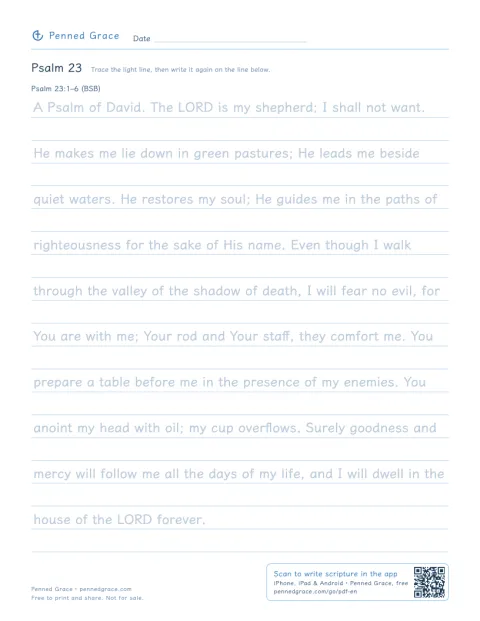
The free printables page has a Psalm 23 copywork page with the whole psalm in the BSB, one line to trace and one to write, in US Letter and A4.
Penned Grace lets you write scripture by hand, letter by letter, on iPhone, iPad or Android, with your finger or Apple Pencil. It is free to download. Its free plan “Psalm 23, Slowly” takes six days, about one verse a day.
For another psalm of trust, read Psalm 91, “He who dwells in the shelter of the Most High.”
Common questions
What is the main message of Psalm 23?
That God cares for the one who trusts Him the way a shepherd cares for a sheep: providing food and water, leading, and staying close in danger. The last two verses add the picture of a generous host, and the psalm ends with the hope of living in the house of the LORD.
What does “I shall not want” mean in Psalm 23:1?
It means “I will lack nothing,” not “I will not desire anything.” The Berean Standard Bible and the KJV keep the older wording “I shall not want.”
Is it “valley of the shadow of death” or “darkest valley”?
Both are translations of the same Hebrew phrase in Psalm 23:4. The KJV, ESV, NASB and BSB use “valley of the shadow of death.” The NIV, NRSV and NLT use “darkest valley.”
Who wrote Psalm 23?
The heading in verse 1 reads “A Psalm of David.” David worked as a shepherd for his father before he became king (1 Samuel 16:11, 17:34–35).
Or write it by hand in the app

Penned Grace, the scripture writing app
Let God’s word hold us close
Works on iOS and Android, on phones and tablets.
Ad-free writing, always.
- Free to download
- No sign-up
- Works offline



Scan with your phone to download
On Android? Get it on Google Play