1 Corinthians 13: Love Is Patient, Love Is Kind (Meaning)
Bible verses by topicPublished ・Penned Grace editors
Short answer
“Love is patient, love is kind” is 1 Corinthians 13:4, the start of a passage that runs to verse 7 and describes love in 15 short phrases in the Berean Standard Bible. Paul wrote it to the church in Corinth, in the middle of a discussion of spiritual gifts in chapters 12 and 14. The chapter has 13 verses and ends with “the greatest of these is love.”

“Love is patient, love is kind” opens 1 Corinthians 13:4, and the description runs through verse 7. Below is the full chapter in the Berean Standard Bible, followed by what each of its three sections is saying.
Where “love is patient” comes from
1 Corinthians is a letter from the apostle Paul to the church in Corinth, a Greek port city. Paul says he will stay in Ephesus until Pentecost (16:8), and most scholars date the letter to around AD 55, written from Ephesus. He was responding to reports of quarrels in the church (1:11) and to questions the Corinthians had sent him in a letter (7:1).
Chapter 12 opens with “Now about spiritual gifts” and covers tongues, prophecy, healing and the church as one body with many parts. Chapter 14 returns to tongues and prophecy and how to use them in worship. Chapter 13 sits between the two. The last verse of chapter 12 introduces it:
But eagerly desire the greater gifts. And now I will show you the most excellent way. (1 Corinthians 12:31, BSB)
and the first verse of chapter 14 picks up where it leaves off: “Earnestly pursue love and eagerly desire spiritual gifts.” The famous description of love was written as part of an argument about gifts, to a church that was competing over them.
1 Corinthians 13 full text (BSB)
Verses 1–3
If I speak in the tongues of men and of angels, but have not love, I am only a ringing gong or a clanging cymbal. If I have the gift of prophecy and can fathom all mysteries and all knowledge, and if I have absolute faith so as to move mountains, but have not love, I am nothing. If I give all I possess to the poor and exult in the surrender of my body, but have not love, I gain nothing. (1 Corinthians 13:1–3, BSB)
Verses 4–7
Love is patient, love is kind. It does not envy, it does not boast, it is not proud. It is not rude, it is not self-seeking, it is not easily angered, it keeps no account of wrongs. Love takes no pleasure in evil, but rejoices in the truth. It bears all things, believes all things, hopes all things, endures all things. (1 Corinthians 13:4–7, BSB)
Verses 8–13
Love never fails. But where there are prophecies, they will cease; where there are tongues, they will be restrained; where there is knowledge, it will be dismissed. For we know in part and we prophesy in part, but when the perfect comes, the partial passes away. When I was a child, I talked like a child, I thought like a child, I reasoned like a child. When I became a man, I set aside childish ways. Now we see but a dim reflection as in a mirror; then we shall see face to face. Now I know in part; then I shall know fully, even as I am fully known. And now these three remain: faith, hope, and love; but the greatest of these is love. (1 Corinthians 13:8–13, BSB)
What the three sections mean
Verses 1–3: gifts without love
Paul uses three “if I … but have not love” sentences: speaking in tongues, prophecy and mountain-moving faith, and giving everything away. These were the things the Corinthians admired. Without love, he says, they amount to noise, to nothing, and to no gain.
Verse 3 has a well-known manuscript difference. Greek copies differ by one letter between “that I may be burned” and “that I may boast.” The KJV, NIV and ESV follow “burned,” while the NRSV and NLT follow “boast.” The BSB’s “exult in the surrender of my body” follows the second reading.
Verses 4–7: what love looks like (1 Corinthians 13:4–7 meaning)
In the BSB, love is described in 15 phrases:
- patient
- kind
- does not envy
- does not boast
- is not proud
- is not rude
- is not self-seeking
- is not easily angered
- keeps no account of wrongs
- takes no pleasure in evil
- rejoices in the truth
- bears all things
- believes all things
- hopes all things
- endures all things
Two say what love is. Seven say what it is not or does not do. Verse 6 sets “takes no pleasure in evil” against “rejoices in the truth,” and the last four begin with “all things.” Most of the list is negative because Paul is describing the opposite of what was happening in Corinth: envy over gifts, boasting and people insisting on their own way.
Every phrase has love as its subject. Some readers try putting their own name in place of “love” to see which lines are hardest to say honestly.
Verses 8–13: what lasts
“Love never fails” (verse 8) is set against prophecies, tongues and knowledge, which will all end. Paul gives two pictures: a child growing up and setting aside childish ways (verse 11), and seeing “a dim reflection as in a mirror” now but “face to face” later (verse 12). Mirrors in the first century were polished metal, so the image was naturally unclear. The chapter closes with faith, hope and love, and names love as the greatest.
Which verses to use at weddings and in cards
Verses 4–7 are among the most familiar wedding readings. Paul wrote them to a whole congregation, and they apply to a marriage as directly as to a church. Choose by the space or time you have:
| Length | Verses | Good for |
|---|---|---|
| One line | 13:4a “Love is patient, love is kind.” | Small cards, invitations |
| One line | 13:8a “Love never fails.” | Ring engravings, photo captions |
| One verse | 13:13 | Wedding and anniversary cards |
| One verse | 13:7 | A card for a spouse or family member |
| Passage | 13:4–7 | Ceremony readings, framed prints |
| Longer | 13:4–8a or the whole chapter | Ceremony readings |
In the Catholic wedding lectionary the reading is 1 Corinthians 12:31–13:8a, from “the most excellent way” to “Love never fails.” Episcopal marriage rites list 1 Corinthians 13:1–13 among the lesson options. In other Protestant churches, couples usually choose the readings with the officiant.
Write it out: verses 4–7 in 14 days
Write one phrase a day, then spend a minute thinking about where it applies today. Days 1 and 9 pair two phrases that belong together, and day 14 is the whole passage:
| Day | What to write | Verse |
|---|---|---|
| Day 1 | Love is patient, love is kind. | 13:4 |
| Day 2 | It does not envy, | 13:4 |
| Day 3 | it does not boast, | 13:4 |
| Day 4 | it is not proud. | 13:4 |
| Day 5 | It is not rude, | 13:5 |
| Day 6 | it is not self-seeking, | 13:5 |
| Day 7 | it is not easily angered, | 13:5 |
| Day 8 | it keeps no account of wrongs. | 13:5 |
| Day 9 | Love takes no pleasure in evil, but rejoices in the truth. | 13:6 |
| Day 10 | It bears all things, | 13:7 |
| Day 11 | believes all things, | 13:7 |
| Day 12 | hopes all things, | 13:7 |
| Day 13 | endures all things. | 13:7 |
| Day 14 | Write all of verses 4–7 | 13:4–7 |
Each line takes only a few minutes. You can note one moment from the day next to it, such as a time you chose not to keep account of a wrong. After two weeks, continue with verses 8–13 or go back to verses 1–3.
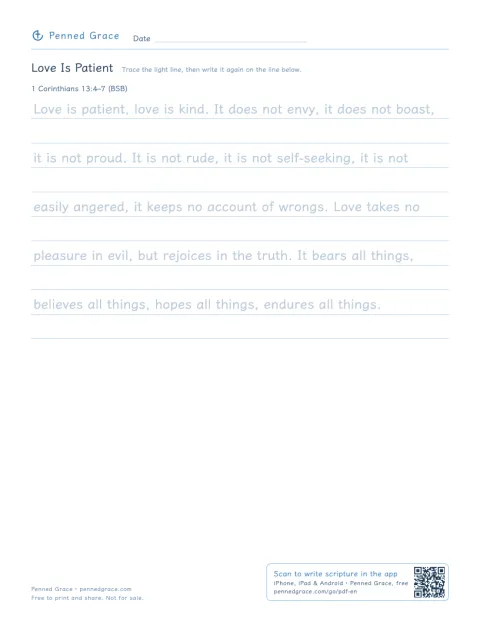
Printable: Love Is Patient
The free printables page has a Love Is Patient copywork sheet with 1 Corinthians 13:4–7, in US Letter and A4, ready to print and trace.
Penned Grace lets you write scripture by hand, letter by letter, on iPhone, iPad or Android, with your finger or Apple Pencil. It is free to download.
Common questions
Where is “love is patient, love is kind” in the Bible?
1 Corinthians 13:4. The description of love continues through verse 7, ending with “It bears all things, believes all things, hopes all things, endures all things.”
How many qualities of love are in 1 Corinthians 13:4–7?
In the Berean Standard Bible there are 15: two things love is (patient, kind), seven things it is not or does not do, the pair in verse 6 (“takes no pleasure in evil, but rejoices in the truth”), and four “all things” phrases.
What does 1 Corinthians 13:4–7 mean?
Paul was writing to a church divided over which spiritual gifts mattered most. Verses 4–7 describe what love looks like in practice, mostly by naming what it does not do, to show that love matters more than any gift.
Which part of 1 Corinthians 13 is read at weddings?
Verses 4–7 are the most common. Some couples read the whole chapter. In the Catholic wedding lectionary, the option is 1 Corinthians 12:31–13:8a.
Or write it by hand in the app

Penned Grace, the scripture writing app
Let God’s word hold us close
Works on iOS and Android, on phones and tablets.
Ad-free writing, always.
- Free to download
- No sign-up
- Works offline



Scan with your phone to download
On Android? Get it on Google Play