Where Is the Lord’s Prayer in the Bible? Matthew 6, Luke 11
Bible factsPublished ・Updated ・Penned Grace editors
Short answer
The Lord’s Prayer is in two places: Matthew 6:9–13, in the Sermon on the Mount, and a shorter version in Luke 11:2–4, where a disciple asks Jesus, “Lord, teach us to pray.” The version most churches pray follows Matthew. The closing line “For thine is the kingdom, and the power, and the glory, for ever. Amen” is in the KJV text of Matthew 6:13 but appears only in a footnote in the BSB and most modern translations.

The Lord’s Prayer is recorded twice in the Gospels: Matthew 6:9–13 and Luke 11:2–4. Here are both passages in the Berean Standard Bible (BSB), the differences between them, what each line means and where the familiar ending “For thine is the kingdom” comes from.
Matthew 6:9–13 (BSB)
In Matthew, the prayer is part of the Sermon on the Mount (Matthew 5–7). Just before it, Jesus warns against praying to be seen and against babbling on with many words, “for your Father knows what you need before you ask Him” (Matthew 6:8, BSB).
So then, this is how you should pray: ‘Our Father in heaven, hallowed be Your name.
Your kingdom come, Your will be done, on earth as it is in heaven.
Give us this day our daily bread.
And forgive us our debts, as we also have forgiven our debtors.
And lead us not into temptation, but deliver us from the evil one.’
(Matthew 6:9–13, BSB)
Luke 11:2–4 (BSB)
In Luke, the prayer is an answer to a request. Jesus had just finished praying, and one of His disciples said, “Lord, teach us to pray, just as John taught his disciples” (Luke 11:1, BSB).
So Jesus told them, “When you pray, say: ‘Father, hallowed be Your name. Your kingdom come.
Give us each day our daily bread.
And forgive us our sins, for we also forgive everyone who sins against us. And lead us not into temptation.’”
(Luke 11:2–4, BSB)
Matthew and Luke side by side
| Matthew 6 | Luke 11 | |
|---|---|---|
| Setting | Sermon on the Mount | A disciple asks to be taught |
| Opening | Our Father in heaven | Father |
| God’s will | Your will be done, on earth as it is in heaven | Not included |
| Bread | Give us this day | Give us each day |
| Forgiveness | our debts | our sins |
| Last request | but deliver us from the evil one | Ends at “lead us not into temptation” |
| Closing praise | In the KJV; footnote in the BSB | None |
Why the BSB has no “For thine is the kingdom”
Compare the end of Matthew 6:13 in two translations:
| Translation | Matthew 6:13 |
|---|---|
| KJV | And lead us not into temptation, but deliver us from evil: For thine is the kingdom, and the power, and the glory, for ever. Amen. |
| BSB | And lead us not into temptation, but deliver us from the evil one. |
The closing praise, called a doxology, is not in the oldest Greek manuscripts of Matthew. It appears in later manuscripts, including the Byzantine text and the Textus Receptus that the KJV translators used. The BSB footnote on 6:13 reads: “Or from evil; BYZ and TR include For Yours is the kingdom and the power and the glory, forever. Amen.” The NIV, ESV and NRSV also leave it out of the main text.
The ending is very old in Christian worship. The Didache, an early Christian manual usually dated to the late first or early second century, ends the prayer with “for yours are the power and the glory for ever.”
Church practice differs:
- Many Protestant churches say the doxology as the last line of the Lord’s Prayer.
- At Catholic Mass, the priest says a short prayer after “deliver us from evil,” and the congregation then responds “For the kingdom, the power and the glory are yours now and for ever.” Outside Mass, Catholics end the Our Father at “deliver us from evil.”
Lord’s Prayer meaning, line by line
“Our Father in heaven, hallowed be Your name”
“Hallowed” means treated as holy. The prayer begins with God, asking that His name be honored, before any request for the one praying.
“Your kingdom come, Your will be done”
The request is for God’s rule to be as complete on earth as it already is in heaven.
“Give us this day our daily bread”
A request for what is needed today. Matthew has “this day,” and Luke has “each day.”
“Forgive us our debts, as we also have forgiven our debtors”
Sin is pictured as a debt owed to God. Right after the prayer Jesus comes back to this one line: “For if you forgive men their trespasses, your heavenly Father will also forgive you” (Matthew 6:14, BSB). The word “trespasses” in many church versions of the prayer goes back to William Tyndale’s 1526 New Testament and the Book of Common Prayer. The KJV itself says “debts.”
“Lead us not into temptation, but deliver us from the evil one”
The Greek can mean “the evil one” or “evil,” and the BSB footnote gives both. The KJV has “deliver us from evil.”
Write out the Lord’s Prayer
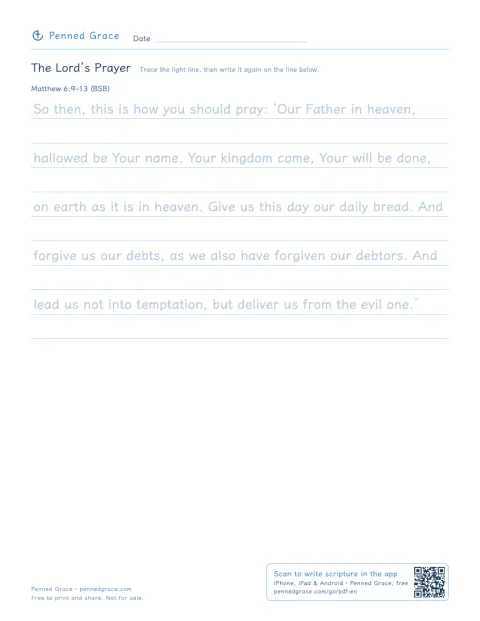
Matthew’s version is about 60 words in the BSB, which takes around five minutes to copy by hand. The free printables page has a Lord’s Prayer copywork page with Matthew 6:9–13 (BSB), one light line to trace and one to write, in US Letter and A4. For a routine, see how to start handwriting scripture.
Penned Grace lets you write scripture by hand, letter by letter, on iPhone, iPad or Android, with your finger or Apple Pencil. It is free to download. Its free plan “The Sermon on the Mount” covers Matthew 5–7, the chapters that contain the Lord’s Prayer, in 34 days.
Common questions
Where is the Lord’s Prayer in the Bible?
Matthew 6:9–13 and Luke 11:2–4. Matthew’s version is longer and is the one most churches pray.
Is “For thine is the kingdom, and the power, and the glory” in the Bible?
It is in the KJV at the end of Matthew 6:13. It is missing from the earliest Greek manuscripts, so the BSB, NIV, ESV and NRSV leave it out of the main text, and the BSB notes it in a footnote. Luke’s version has no closing line in any of these translations.
Why do some churches say “debts” and others “trespasses”?
Matthew 6:12 says “debts” in the KJV and BSB. William Tyndale’s 1526 New Testament used “trespasses,” and the Book of Common Prayer adopted that wording, so many liturgical churches say “trespasses.” Churches that take the prayer straight from the KJV, such as many Presbyterian churches, say “debts.”
What is the difference between Matthew’s and Luke’s Lord’s Prayer?
Luke’s is shorter. It begins “Father” instead of “Our Father in heaven,” has no line about God’s will being done, asks for bread “each day,” says “sins” instead of “debts,” and ends at “lead us not into temptation.”
Or write it by hand in the app

Penned Grace, the scripture writing app
Let God’s word hold us close
Works on iOS and Android, on phones and tablets.
Ad-free writing, always.
- Free to download
- No sign-up
- Works offline



Scan with your phone to download
On Android? Get it on Google Play